
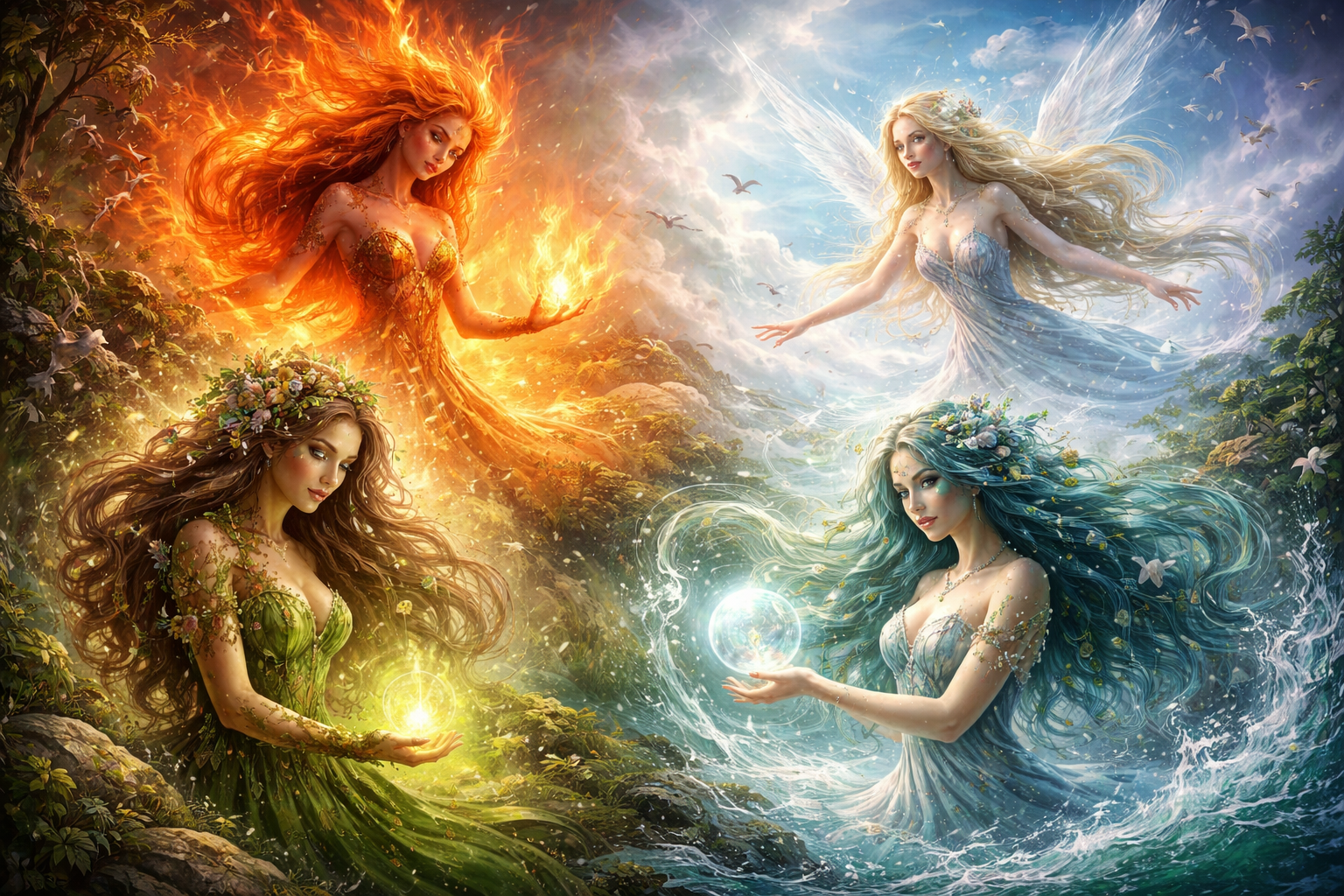

Elementals are said to be non-human spiritual entities associated with the forces and substances of nature. Across spiritualist, esoteric and folkloric traditions, they are understood as consciousness expressed through the natural world rather than spirits of deceased people. When people ask “What are Elementals?” they are usually asking whether these beings are symbolic, psychological, or genuinely independent forms of spirit life. The honest answer is that different traditions give different explanations.
In spiritual thought, elementals are not angels, not guides, and not ghosts. They are typically described as nature-bound intelligences, linked to the classical elements of earth, air, fire and water. They appear in folklore, ceremonial magic, Theosophy, modern spiritualism and contemporary spiritual wellbeing discussions, often under different names but with strikingly similar characteristics.
The traditional elemental groups
Most modern discussions of elementals draw on a four-fold classification that mirrors ancient cosmology.
Earth elementals are often called gnomes. They are associated with soil, stone, plants and physical matter. Symbolically, they represent stability, growth and material form. In spiritual language, they are sometimes linked to grounding, embodiment and connection to the land.
Air elementals, commonly referred to as sylphs, are associated with wind, breath and atmosphere. They are described as light, fast and elusive, connected to thought, communication and inspiration rather than physical form.
Fire elementals, sometimes called salamanders, are linked to flame, heat and transformation. They are not usually described as “warm” or comforting but as intense, catalytic and volatile—mirroring the creative and destructive aspects of fire itself.
Water elementals, often known as undines, are associated with rivers, oceans and rain. They are frequently connected with emotion, intuition and flow, and appear widely in folklore as mer-beings or water spirits.
These labels are not fixed truths or rigid classifications. They are part of a symbolic framework developed over centuries to help people describe how consciousness, nature and the unseen might interact. Different traditions use different names, but the underlying ideas remain broadly consistent.
Are elementals real or symbolic?
This is one of the most common questions people ask, and it deserves a clear answer rather than mystical hand-waving.
From a spiritualist perspective, elementals are usually understood as real but non-human intelligences, operating on a different vibrational level to human spirit. That does not require blind belief. Spiritualism has always encouraged personal experience, evidence and discernment, rather than fixed doctrine.
Others interpret elementals psychologically or symbolically, as representations of natural forces within the human psyche. These interpretations are not mutually exclusive. Spiritualism has long accepted that symbol, perception and spirit reality can overlap.
What matters is not proving elementals in a laboratory sense, but understanding how humans relate to nature, consciousness and the unseen.
Can people see or communicate with elementals?
Claims of seeing elementals appear throughout history, from folklore encounters to modern clairvoyant experiences. People describe impressions rather than clear physical forms, fleeting shapes, colours, movements or presences sensed rather than observed.
In spiritualist development circles, contact with elementals is not generally encouraged as a goal. Unlike spirit guides, elementals are not believed to exist to teach or protect humans. Any perceived interaction should be approached cautiously, with grounding and discernment. Spiritualism prioritises balance, mental wellbeing and ethical development over chasing unusual experiences.
Are elementals dangerous?
Most traditions do not describe elementals as malicious, but they are often portrayed as indifferent to human concerns. This distinction matters. They are said to follow natural laws rather than moral ones. Fire burns. Water floods. Nature does not negotiate.
From a spiritual wellbeing standpoint, the real risk lies not in elementals themselves but in misinterpretation, fantasy or obsession. Over-romanticising spiritual entities can distract from grounded spiritual practice, emotional health and everyday responsibility. Spiritualism consistently teaches that curiosity should be paired with stability and common sense.
Elementals and modern spiritual practice
In contemporary spirituality, elementals are often discussed in environmental or ecological language. They are used as a way to express reverence for nature and the idea that the natural world is alive with meaning rather than inert matter.
Within spiritualist communities, this tends to be framed symbolically rather than literally. Respect for nature, mindfulness, and awareness of interconnectedness are emphasised far more than attempting communication with non-human entities.
If you are interested in how spiritualism understands the relationship between spirit and the natural world more broadly, you may find our introduction to spiritualist philosophy helpful:
What is Spiritualism?
Other types of spirit entities
Elementals are only one category within a much wider spiritual landscape.
Human spirits, often referred to as those in the spirit world, are central to spiritualist belief. These are the spirits of people who have lived physical lives and continue to exist after death. Mediumship is primarily concerned with communication with these spirits.
Spirit guides are understood as non-physical helpers who work with individuals to support moral, emotional and spiritual development. They are not elementals and are not nature-bound. Read more about Spirit Guides.
Angelic or higher intelligences appear in some spiritualist interpretations, though spiritualism generally avoids rigid hierarchies. These are seen as evolved states of consciousness rather than supernatural rulers. Read more about Angels.
Nature spirits and folklore beings, such as fairies or land spirits, often overlap conceptually with elementals. Spiritualism tends to treat these descriptions carefully, recognising cultural symbolism while remaining grounded in evidence-based spiritual experience.
You can explore related perspectives in our articles on spirit guides and spiritual development, which place experience and personal responsibility at the centre of spiritual growth.
A grounded conclusion
So, what are Elementals? They are best understood as a way of describing the intelligence and vitality of nature, whether taken literally, symbolically, or somewhere in between. Spiritualism does not demand belief in them, nor does it dismiss centuries of human experience and storytelling.
The forward-thinking spiritual question is not whether elementals exist, but how humans relate responsibly to the natural world, to unseen dimensions of life, and to their own inner experience. Spiritualism’s strength has always been its refusal to drift into fantasy while remaining open to mystery.
Have you had an experience with Elementals? Comment below!
The article was drafted using Chat GPT AI and edited by Humans. The featured image was created by Chat GPT.